


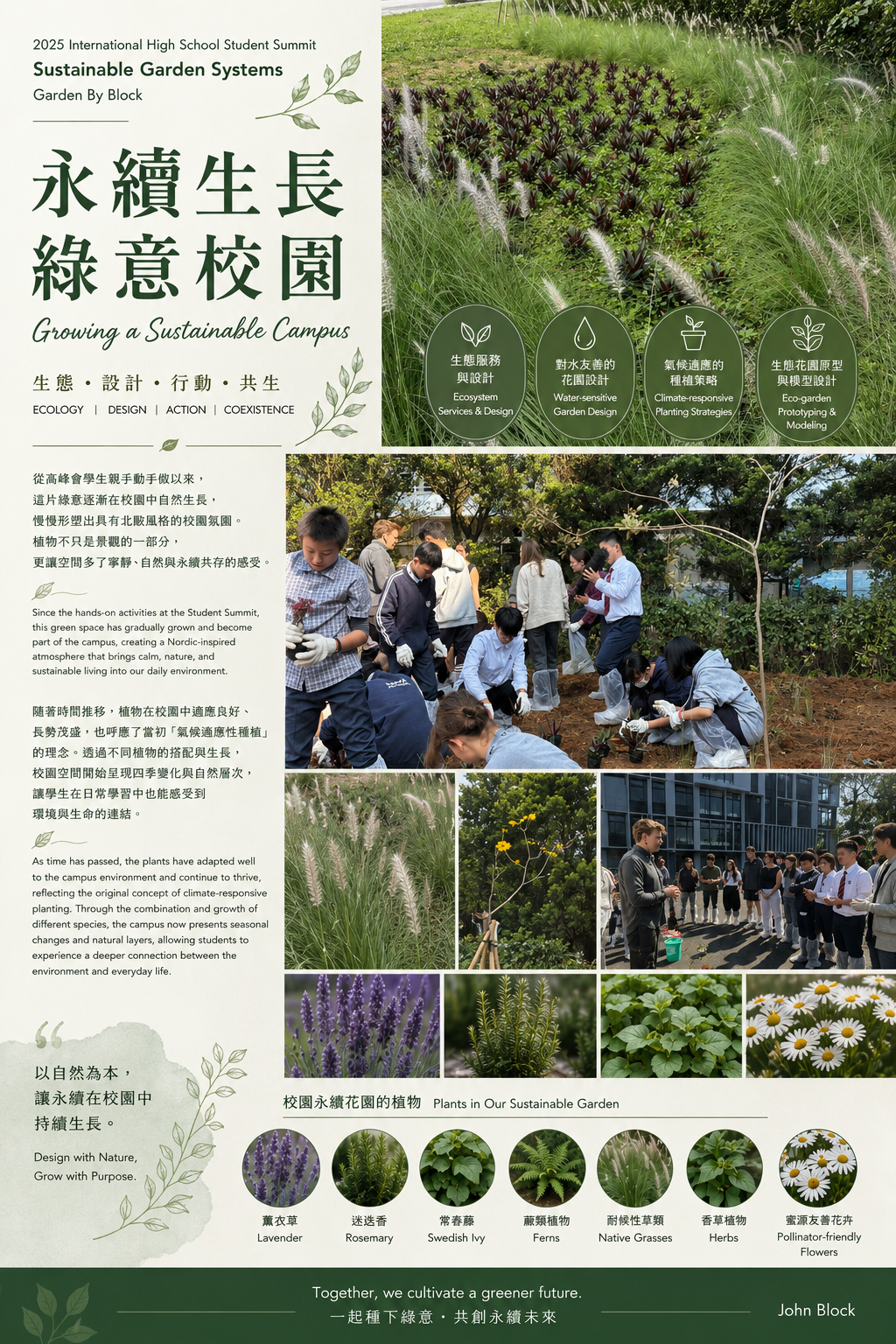
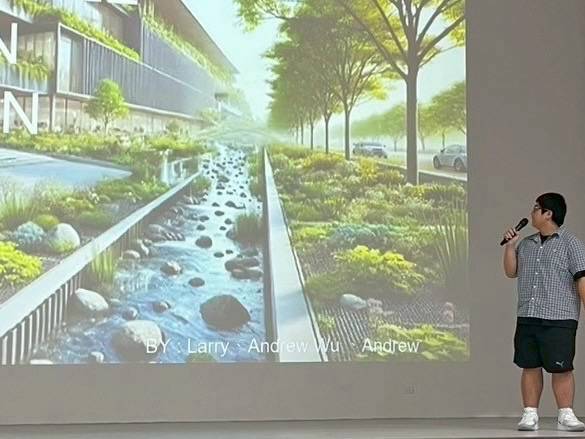
During 2025 LUYA International Student Summit, students Larry Hsieh, Andrew Wu, and Andrew Chou presented their project, Sustainable Garden Design, demonstrating how youth-led innovation can contribute to global sustainability efforts.
The project addresses critical challenges related to water conservation and environmental protection by proposing a nature-based water recycling system. Central to the design is a gravity-fed biological filtration tier, inspired by natural wetland ecosystems. The system utilizes layers of sand, gravel, and plant roots to purify rainwater and greywater without heavy mechanical intervention, showcasing an environmentally responsible and energy-efficient approach.
A distinctive element of the design is its solar-powered recycling loop. Water collected and filtered in an eco-pond or underground cistern is circulated using solar energy to irrigate the garden and re-enter the filtration process. This closed-loop system minimizes water waste while promoting renewable energy use and sustainable landscape management.
Through their presentation, the students evaluated both the strengths and limitations of their proposal. They emphasized benefits such as reduced water consumption, pollution mitigation, ecological enhancement, and visual appeal, while also acknowledging practical challenges, including high installation costs, spatial requirements, and maintenance complexity.
The Sustainable Garden Design project reflects the summit’s focus on empowering students to engage with real-world environmental issues through research, systems thinking, and interdisciplinary collaboration. By translating sustainability concepts into actionable design solutions, the students exemplified how international youth dialogue can lead to meaningful contributions toward more resilient and sustainable communities.






_251222_1.jpg)

